
What is a Credit Score?
A credit score is a number generated by a mathematical formula that is meant to predict credit worthiness. Credit scores range from 300-850. The higher your score is, the more likely you are to get a loan. The lower your score is, the less likely you are to get a loan. If you have a low credit score and you do manage to get approved for credit then your interest rate will be much higher than someone who had a good credit score and borrowed money. Therefore, having a high credit score can save many thousands of dollars over the life of your mortgage, auto loan, or credit card.
What affects your Credit Score?
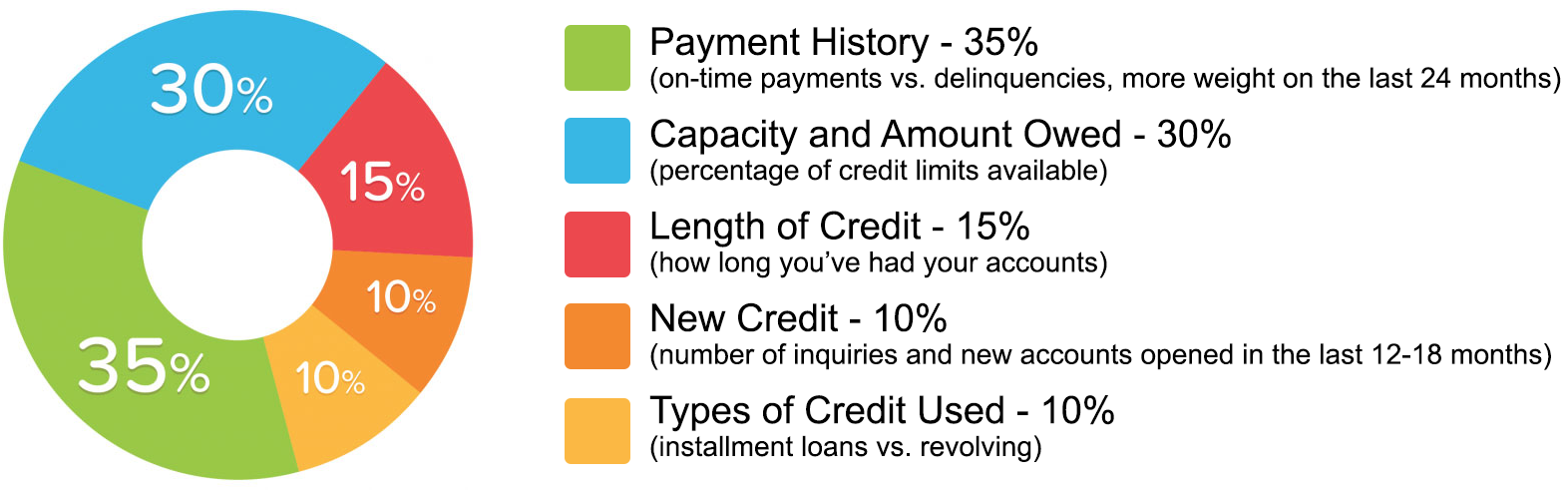
We will help you to dispute negative items in your payment history.
Credit Optimization & Credit Report ReviewWe will show you how to maximize your credit score by improving your debt-to-credit utilization ratio—even if paying off your credit cards is not currently an option.
We also assist with disputing eligible credit inquiries and identifying inaccurate, outdated, or unverifiable information that may be impacting your credit profile.
Many consumers are familiar with the three major credit reporting agencies—Equifax®, Experian®, and TransUnion®. Because each bureau may report different information, it is common for credit scores to vary. In many cases, reports contain incomplete, outdated, or inaccurate information that may affect your overall creditworthiness.
Industry studies have found that many credit reports contain errors or inconsistencies. Our team carefully reviews your reports to identify potential issues and work toward improving the accuracy of your credit file in accordance with applicable consumer protection laws.
Our Satisfaction GuaranteeIf we are unable to achieve the removal of at least 25% of the eligible negative items we work on across your three credit reports, in accordance with the terms of our service agreement, we will refund 100% of the fees you paid.
We also assist with disputing eligible credit inquiries and identifying inaccurate, outdated, or unverifiable information that may be impacting your credit profile.
Many consumers are familiar with the three major credit reporting agencies—Equifax®, Experian®, and TransUnion®. Because each bureau may report different information, it is common for credit scores to vary. In many cases, reports contain incomplete, outdated, or inaccurate information that may affect your overall creditworthiness.
Industry studies have found that many credit reports contain errors or inconsistencies. Our team carefully reviews your reports to identify potential issues and work toward improving the accuracy of your credit file in accordance with applicable consumer protection laws.
Our Satisfaction GuaranteeIf we are unable to achieve the removal of at least 25% of the eligible negative items we work on across your three credit reports, in accordance with the terms of our service agreement, we will refund 100% of the fees you paid.
In addition to starting the credit dispute process with you, what can I do to help raise my credit score?
Credit Tips for Building and Maintaining Strong CreditImproving your credit score takes consistency, patience, and smart financial habits. Follow these proven tips to build and maintain healthy credit.
Pay Every Bill on TimeYour payment history is one of the most important factors affecting your credit score. Make every payment on or before the due date, including:
Review Your Credit Reports RegularlyCheck your credit reports at least once a year with all three major credit bureaus—Equifax®, Experian®, and TransUnion®. Review them for inaccurate, outdated, or unverifiable information and dispute any errors promptly.
Keep Credit Card Utilization LowTry to use no more than 30% of your available credit limit on each credit card. Lower utilization can have a positive impact on your credit score.
Example:
If your credit limit is $1,000, try to keep your balance below $300.
Continue Using Credit ResponsiblyAvoid closing yourself off from credit completely. Responsible credit use demonstrates positive payment history.
A good strategy is to:
If you no longer use a card, make a small purchase every few months and pay it off promptly to help keep the account active.
Be PatientBuilding excellent credit doesn't happen overnight. Positive financial habits practiced consistently over time can help improve your credit profile and increase your opportunities to qualify for:
Pay Every Bill on TimeYour payment history is one of the most important factors affecting your credit score. Make every payment on or before the due date, including:
- Credit cards
- Auto loans
- Mortgage payments
- Utility bills
- Personal loans
Review Your Credit Reports RegularlyCheck your credit reports at least once a year with all three major credit bureaus—Equifax®, Experian®, and TransUnion®. Review them for inaccurate, outdated, or unverifiable information and dispute any errors promptly.
Keep Credit Card Utilization LowTry to use no more than 30% of your available credit limit on each credit card. Lower utilization can have a positive impact on your credit score.
Example:
If your credit limit is $1,000, try to keep your balance below $300.
Continue Using Credit ResponsiblyAvoid closing yourself off from credit completely. Responsible credit use demonstrates positive payment history.
A good strategy is to:
- Charge a small recurring bill, such as a utility or streaming service.
- Pay the balance in full each month.
- Avoid carrying unnecessary debt.
If you no longer use a card, make a small purchase every few months and pay it off promptly to help keep the account active.
Be PatientBuilding excellent credit doesn't happen overnight. Positive financial habits practiced consistently over time can help improve your credit profile and increase your opportunities to qualify for:
- Lower interest rates
- Higher credit limits
- Better loan approvals
- Mortgage financing
- Auto financing
How long will certain items remain on my credit file?
- Delinquencies (30- 180 days): A delinquency may remain on file for seven years; from the date of the initial missed payment.
- Collection Accounts: May remain seven years from the date of the initial missed payment that led to the collection (the original delinquency date). When a collection account is paid in full, it will be marked as a "paid collection" on the credit report.
- Charge-off Accounts: When a delinquent account is sent to a collections company. This will remain for seven years from the date of the initial missed payment that led to the charge-off (the original delinquency date), even if payments are later made on the charge-off account.
- Closed Accounts: Closed accounts are no longer available for further use and may or may not have a zero balance. Closed accounts with delinquencies remain for seven years from the date they are reported closed, whether closed by the creditor or by the consumer. However, the delinquency notation will be removed seven years after the delinquency occurred when pertaining to late payments. Positive closed accounts continue to be reported for ten years from the closing date.
- Lost Credit Card: If there are no delinquencies, credit cards reported as lost will continue to be listed for two years from the date the creditor is contacted. Delinquent payments that occurred before the card was lost are reported for seven years.
- Bankruptcy: Chapters 7, 11, and 12 will remain on one's credit report for ten years from the filing date. A Chapter 13 bankruptcy is reported for seven years from the filing date. Accounts included in a bankruptcy will remain for seven years from the date reported as included in the bankruptcy
- Judgments: Remain seven years from the date filed.
- City, County, State, and Federal Tax Liens: Unpaid tax liens remain for fifteen years from the filing date. A paid tax lien will remain on one's score for 10 years from the date of payment.
- Inquiries: Most inquiries listed on one's credit report will remain for two years. All inquiries must remain for a minimum of one year from the date the inquiry was made. Some inquiries, such as employment or pre-approved offers of credit, will show only on a personal credit report pulled by you.
Information that cannot be in a credit report:
- Information That Generally Should Not Appear on Your Credit ReportCertain types of information are restricted or limited under federal law. Depending on the circumstances, your credit report generally should not include:
- Medical information without your authorization, except as permitted by law.
- Chapter 11 bankruptcy filings that are more than 10 years old.
- Most delinquent debts, including delinquent child support, that are more than 7 years old (subject to certain legal exceptions).
- Age, marital status, or race when a credit report is requested by a current or prospective employer, except where permitted by applicable law.
- If you believe your credit report contains inaccurate, outdated, or improperly reported information, Empiher Elite Credit can review your reports and help you understand your options for disputing eligible items under the Fair Credit Reporting Act (FCRA).


